
Burnsville, MN · Garage Door Service
Openers and Power Outages: What Burnsville Garage Doors Are Actually Up Against
Burnsville homes built mostly 1956-2005 run openers that struggle in cold snaps and outages. Here's what drives repair cost, what the climate does to your opener, and how to check it yourself.
- Repairs & new doors
- Springs & openers
- Serving 7 nearby communities
The Cost of This Job
We're not going to quote you a number here, because an opener call can mean a $40 sensor realignment or a full motor swap, and we don't know which one you've got until we're standing in front of it. What we can tell you is what drives the range. A lot of Burnsville garages still run the opener that came with the house, and with most of this housing stock going up between 1956 and 2005 (median build year around 1970), that opener is often a second or third generation unit - chain-drive, no battery backup, a circuit board that was never built to handle a hard power outage in freezing weather. Parts for those older gear sets aren't something every supplier stocks, and if yours is a less common chain-drive model from that era, we may need to order the part rather than carry it on the truck. That's the honest limitation: we can diagnose fast, but a part on backorder is a part on backorder. If your opener dies during a cold snap and the belt or gear has cracked from the temperature swing, replacement usually beats another round of patch repairs on a unit that old.
What Local Conditions Do
Burnsville sits in a cold-moderate climate band, and that matters more for openers than most people think. Cold doesn't just slow the motor down - it thickens the grease on the rail, shrinks metal gear teeth just enough to throw off mesh, and puts more draw on a circuit board that's already drawing hard to lift a door that's heavier because the weatherstripping has stiffened. Pair that with a power outage, which happens more in winter storms than any other season, and you get the classic complaint: the opener hums but the door doesn't move, or the battery backup - if there even is one - drains in under an hour instead of running the rated cycles. Across the roughly 78,670 owner-occupied houses in this part of the service area, the openers installed during the 1960s-70s building wave weren't speced with battery backup at all, so a cut just means a dead opener until the power's back or someone pulls the manual release. That's not a flaw in your specific unit - it's what an opener from that era was built for, and it wasn't built for this.
Checking It Yourself
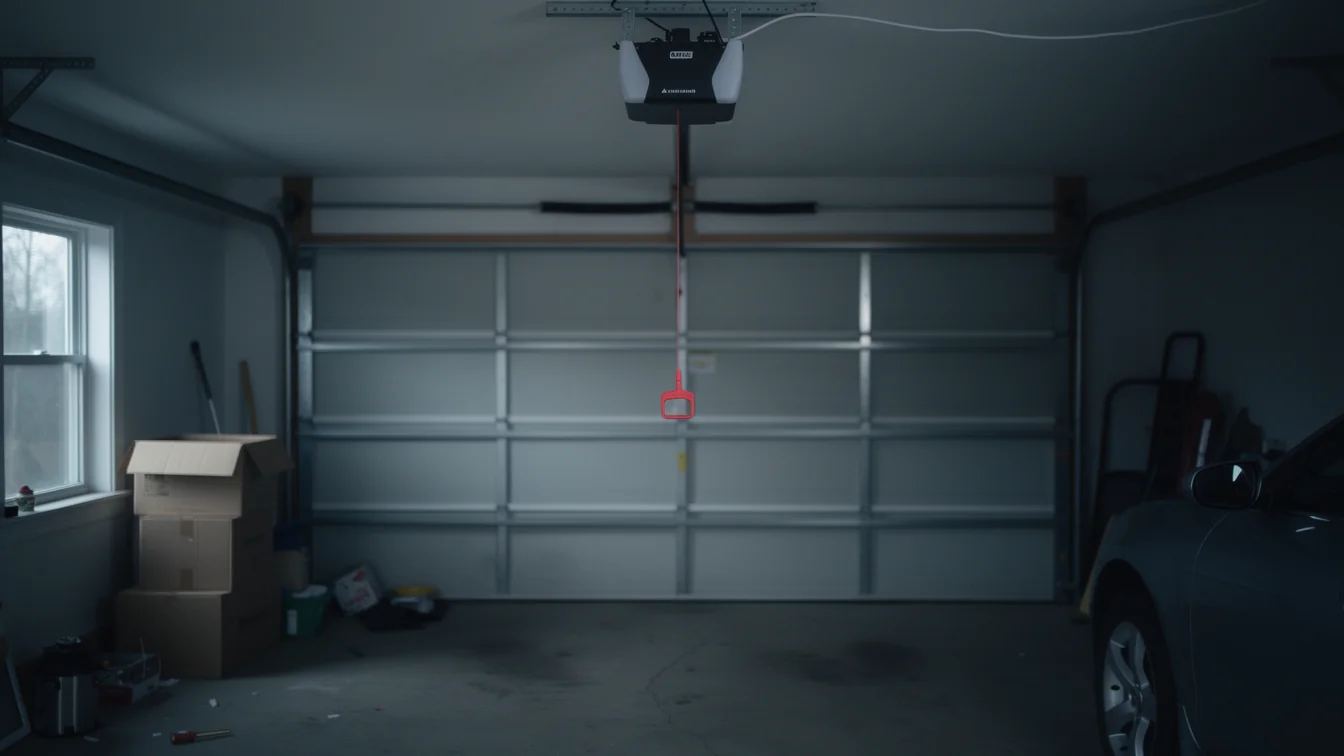
Before you call anyone, there are a few things worth ten minutes of your time. First, pull the manual release cord (the red one hanging from the trolley) and see if the door moves freely by hand - if it's stiff or won't budge, the problem is mechanical, not electrical, and a new opener won't fix it. Second, if you do have a battery backup unit, check the indicator light; in cold-moderate climates like ours, backup batteries lose capacity faster once temperatures drop and often need replacing every few years regardless of how little they're used. Third, look at the safety sensors near the floor on each side of the track - a cut in power sometimes knocks them out of alignment when the door's manually operated, and a blinking light on the opener head usually means that's the whole problem. None of this requires tools. What it does require is honesty about what you find: if the door's heavy to lift by hand, that's a spring or cable issue hiding behind what looked like an opener problem, and that's not a DIY fix.
What Is Going On
Here's the chain of events we see most: a winter storm knocks the power out, the opener's circuit board resets, and when the power comes back the opener either doesn't respond to the remote or runs the door partway and stops. On houses from the 1956-2005 building wave that make up most of Burnsville, that reset often reveals a problem that was already there - worn limit switches, a gear set that was already slipping, or a backup battery that quietly died months ago and nobody noticed until the grid did its part. The opener isn't usually the root cause; it's the thing that finally shows you the root cause. A cold-moderate climate accelerates all of this because the opener's motor and board run warmer and harder just to overcome stiffer grease and heavier, frost-swollen door panels. So when a power outage and a cold snap land in the same week, which they often do here, you get a cluster of calls that look like opener failures but are really years of wear finally catching up at once.
Frequently asked questions
Why does my opener stop working every time the power goes out?
Most openers in homes from Burnsville's main building era (1956-2005) don't have battery backup, so a power outage just kills them outright until power returns or you use the manual release. If you do have a backup battery, cold weather shortens its runtime, which is why it can die faster here than the manufacturer's rated cycle count suggests.
Is it worth adding battery backup to an older opener?
Often yes, since a cold-moderate climate means winter power outages aren't rare here, but it depends on your opener's age and whether a backup unit is even compatible. Some of the chain-drive models common in 1960s-70s Burnsville garages need a full opener swap rather than a bolt-on battery, so it's worth a look before you buy a backup kit.
My door won't budge by hand after a power outage - is that the opener?
No. If the door is stiff or won't move with the manual release pulled, that's a spring, cable, or track problem, not an electrical one. Fixing or replacing the opener won't change anything until the mechanical issue underneath it is addressed.
Related garage door services in Burnsville
More garage door guides
Book garage door service in Burnsville
Call now or request a quote - tell us what the door is doing and where you are.